
Global #1 Open Source Graphics Model Update! Deep Comparison of Z-Image vs Z-Image-Turbo
Global #1 Open Source Graphics Model Update! Z-Image Released: Z-Image vs Z-Image-Turbo
Generating a high-quality image takes less than a second, runs smoothly on consumer-grade graphics cards, and renders Chinese and English text accurately—Alibaba Tongyi's latest open-source image generation model, Z-Image, is redefining the boundaries of AI painting.
Late at night on January 27, 2026, Alibaba Tongyi Laboratory officially released the brand-new image generation foundation model, Z-Image. Compared to Z-Image-Turbo, the Z-Image standard model has been upgraded in many aspects, offering higher quality and freedom, but the 24G VRAM requirement may discourage some eager users. Let's see what this "Turbo-less" Z-Image brings to the table!
I. Z-Image vs Z-Image-Turbo
| Aspect | Z-Image | Z-Image-Turbo |
|---|---|---|
| CFG | ✅ | ❌ |
| Steps | 28~50 | 8 |
| Fine-tunability | ✅ | ❌ |
| Negative Prompts | ✅ | ❌ |
| Diversity | High | Low |
| Visual Quality | High | Extremely High |
| Reinforcement Learning (RL) | ❌ | ✅ |
| Core Positioning | High-performance flagship, pursuing ultimate image quality | Extreme speed inference, focused on real-time generation |
| Parameter Scale | 6B (6 Billion) | Distilled based on 6B, smaller size |
| Training Data | Pure real-world data, no distillation dependency | Inherits base data system, optimized via distillation |
| Core Architecture | S3-DiT single-stream cross-modal architecture | Streamlined version of the same architecture, adapted for fast inference |
| Training Cost | ~$628k (314K H800 GPU Hours) | Optimized based on base model, lower cost |
II. Sample Comparison

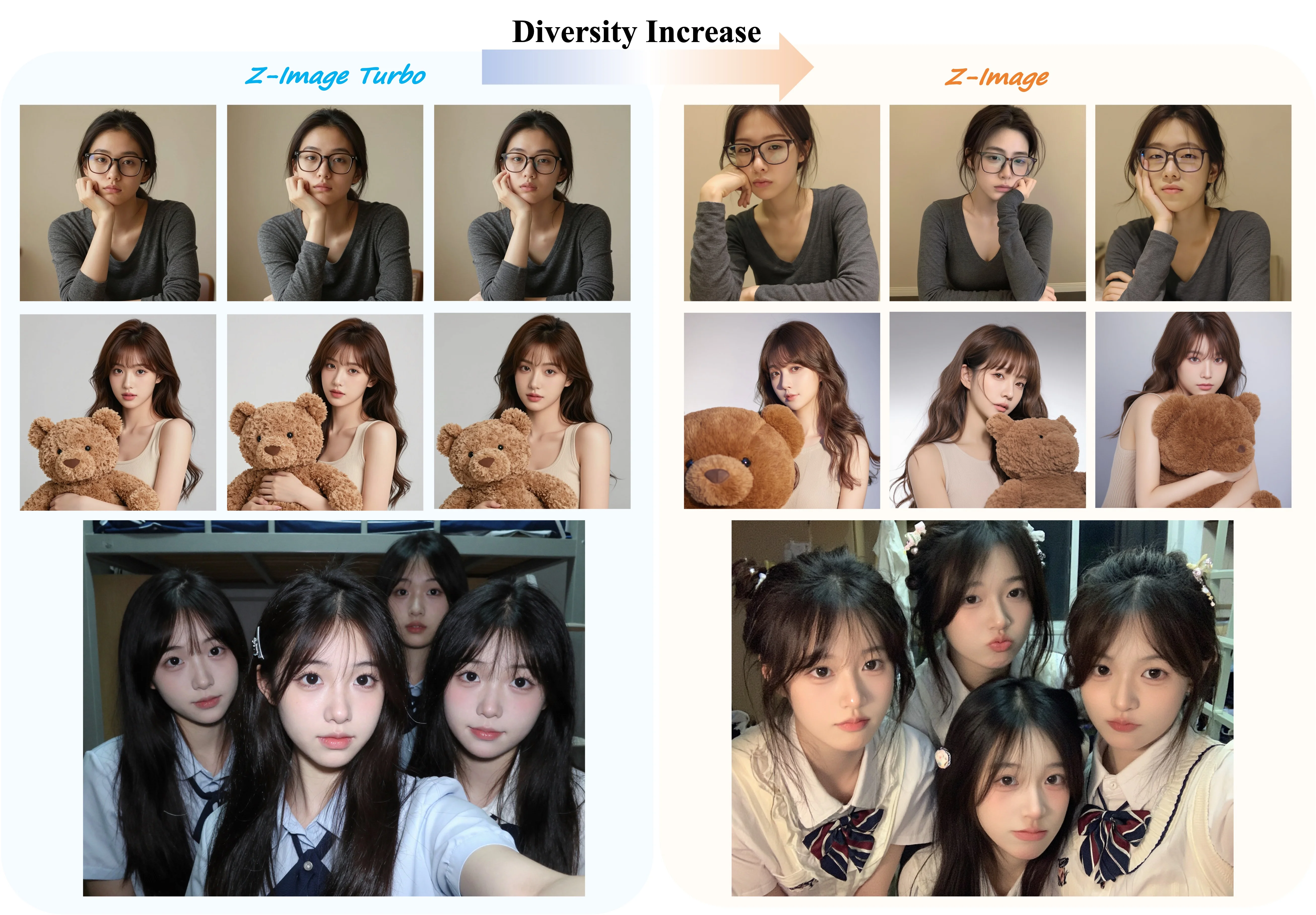
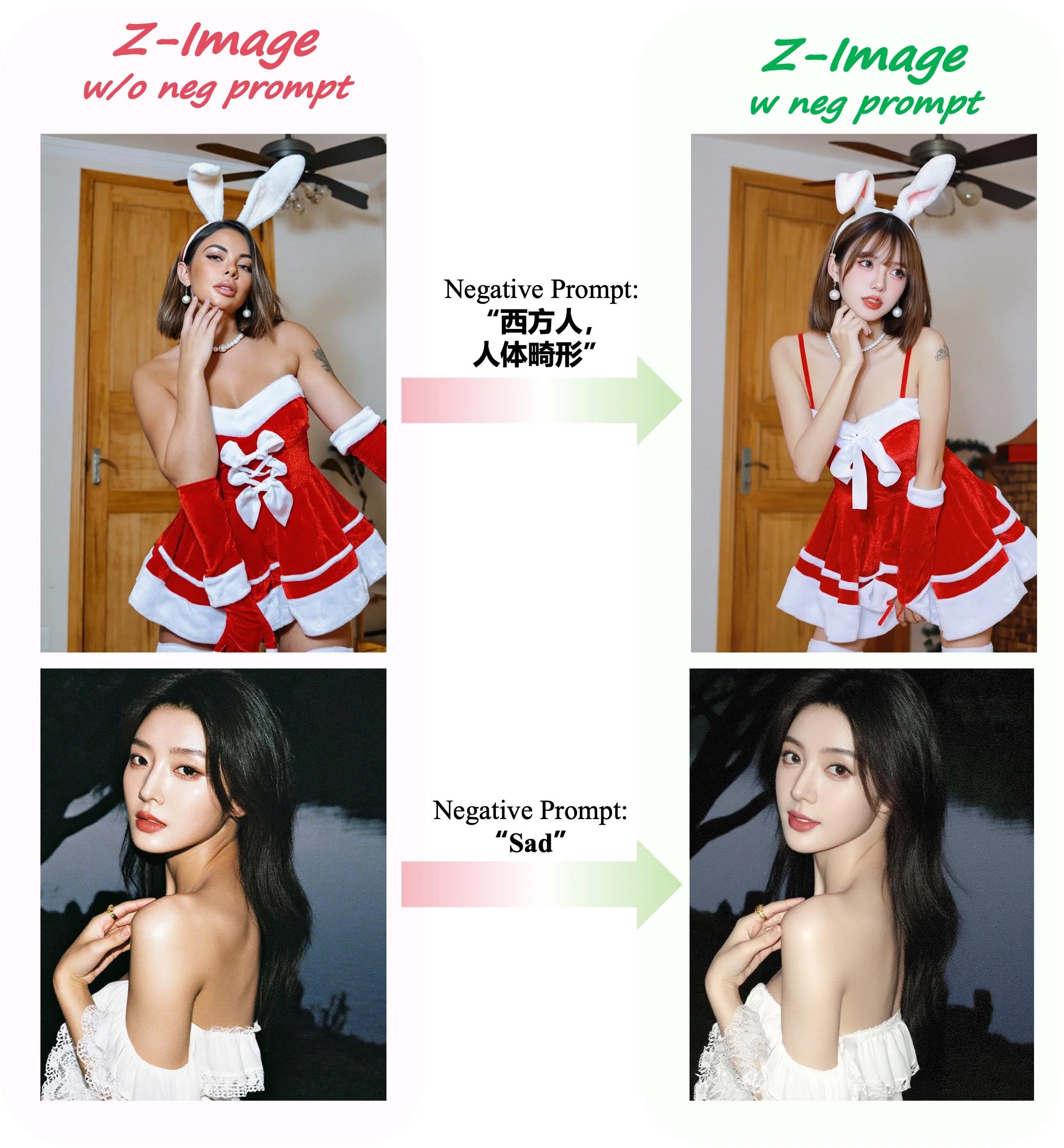
III. Detailed Comparison of Performance and Hardware Requirements
1. Core Generation Performance Indicators
| Performance Indicator | Z-Image (Latest) | Z-Image-Turbo |
|---|---|---|
| Sampling Steps | Recommended 20-25 steps (supports up to 50) | High-quality images in just 8 steps |
| Generation Speed (1024×1024) | 3-5 sec/image (24GB VRAM) | 3.4 sec/image (8 steps, 24GB VRAM) |
| Image Resolution | Supports high-resolution output, richer details | Default 1024×1024, balances speed and quality |
| Text Rendering | Accurate mixed Chinese/English rendering, supports complex layout | Bilingual text generation, no garbled text or misalignment |
| Lighting & Shadow | Natural transitions, texture close to professional photography | Excellent lighting effects, meets daily scenario needs |
| Instruction Understanding | Built-in prompt enhancement, supports complex instructions | Basic instruction understanding, adapted for fast response scenarios |
2. Hardware Configuration Requirements
| Hardware Spec | Z-Image (Latest) | Z-Image-Turbo |
|---|---|---|
| Minimum VRAM | 12GB (Base resolution generation) | 8GB (512-768 resolution) |
| Recommended VRAM | 24GB (High resolution + multi-step) | 12GB (768×768 resolution, 24 steps) |
| Compatible GPU | Consumer-grade GPU (RTX 3090/4090, etc.) | Consumer-grade GPU (RTX 3060/4060 and above) |
| RAM Requirement | 16GB+ | 16GB+ |
| Deployment Framework | PyTorch 2.5.0 + CUDA 12.4 | Same framework, adapted for lighter deployment |
| VRAM Optimization | Supports FP16 standard deployment, optimizable to FP8 | Default FP8 optimization, lower VRAM usage |
Real-world test data reference: In an RTX 4090 (24GB) environment, Z-Image generating a 1024×1024 image (20 steps) takes about 4.2 seconds, while Z-Image-Turbo at the same resolution (8 steps) takes 3.4 seconds. The speed difference mainly comes from sampling step optimization.
IV. Model Evaluation and Application Scenario Analysis
1. Z-Image (Latest) Core Advantages
- Image Quality Ceiling: As the series flagship, its generated images reach new heights in detail richness, skin texture, and lighting depth. Portrait realism is comparable to commercial models, suitable for professional design, advertising, and other scenarios with extremely high image quality requirements.
- High Data Reliability: Pure real-world data training brings better scenario rationality, avoiding common logical fallacies of distilled models. It performs outstandingly in creative concept art, product design, and other scenarios requiring logical consistency.
- Commercial Friendly: Open source with clear commercial licenses, resolving copyright disputes of traditional models, allowing enterprise users to integrate with confidence.
2. Scenario Segmentation for Both Models
-
Scenarios Prioritizing Z-Image (Latest):
- Professional poster design, advertising production, product promotional images, and other commercial scenarios.
- High-resolution image generation, complex scene creative design, fine text layout needs.
- Scientific research, model secondary development, application scenarios requiring ultimate performance.
-
Scenarios Prioritizing Z-Image-Turbo:
- Real-time generation needs (e.g., live streaming illustrations, short video creation, online design tools).
- Individual users or small teams with limited hardware resources (only 8GB VRAM).
- Batch generation, automated illustration, API integration, and other scenarios with high speed requirements.
3. Industry Impact and Limitations
- Breakthrough Significance: Achieving 30B+ level model performance with 6B parameters proves the "design over brute force" R&D philosophy, providing a low-cost model for the industry to build SOTA models.
- Inclusive Value: Deployable on consumer-grade graphics cards, lowering the technical threshold for AI painting, allowing individual creators and SMEs to enjoy top-tier generation capabilities.
- Existing Deficiencies: Z-Image has high VRAM requirements for maximum resolution generation, and creative divergence in some complex scenarios still has room for improvement; the Turbo version is slightly inferior to the flagship version in extremely complex text layout.
Online Experience Addresses
V. My Summary
I wonder if you are satisfied with this Z-Image release? Feel free to discuss in the comments section. Personally, I feel it is reasonable but far below expectations. The reason is simple: expectations were too high. ZIT was a hit right out of the gate, peaking immediately. Extreme speed and extreme quality created extreme expectations among users. This release feels more like a connecting transition, turning a very strong "toy" into a "tool", but I hope to see the other two more playable models, Z-Image-Omni-Base and Z-Image-Edit, sooner rather than later.
Can you guess how long until the next release? And which model will be released next?