

Z-Image GGUF 技术白皮书:S3-DiT 架构与量化部署深度解析
Z-Image GGUF 实战指南:用消费级显卡解锁顶尖 AI 绘画(深入版):Z-Image Turbo 架构解析与 GGUF 量化部署技术白皮书
1. 技术背景:从 UNet 到 S3-DiT 的范式跃迁
在生成式 AI 领域,Z-Image Turbo 的出现标志着架构设计的一次重要迭代。不同于 Stable Diffusion 1.5/XL 时代基于 CNN 的 UNet 架构,Z-Image 采用了更为激进的 Scalable Single-Stream Diffusion Transformer (S3-DiT) 架构。
1.1 单流 (Single-Stream) vs 双流 (Dual-Stream)
传统的 DiT(如 Flux 的部分变体)通常采用双流架构,即文本特征和图像特征在网络的大部分层中独立处理,仅在特定的 Cross-Attention 层进行交互。这种设计虽然保留了模态独立性,但参数效率较低。
S3-DiT 的核心创新在于“单流”设计:
- 它将文本 Token、视觉语义 Token 以及图像 VAE Token 在输入端直接拼接,形成一个 Unified Input Stream。
- 这意味着模型在每一层 Transformer Block 的 Self-Attention 计算中,都在进行全模态的深度交互。
- 优势:这种深度融合是 Z-Image 具备卓越双语(中英)文本渲染能力的物理基础。模型不再是“看着”文本画图,而是将文本视为图像笔画结构的一部分。
2. 量化原理:GGUF 的数学与工程实现
为了在消费级硬件上运行 60 亿参数(6B)的模型,我们引入了 GGUF (GPT-Generated Unified Format) 量化技术。这不仅仅是简单的权重截断,而是包含了一系列复杂的算法优化。

2.1 K-Quants 与 I-Quants
- K-Quants (Block-based Quantization):传统的线性量化对离群值(Outliers)敏感。GGUF 采用基于块的策略,将权重矩阵划分为微小的 Block(如每 32 个权重一组),并对每个 Block 独立计算 Scale 和 Min。这极大地保留了权重分布的特征。
- I-Quants (Vector Quantization):Z-Image 的部分 GGUF 变体引入了 I-Quants。它不再单独存储每个权重,而是利用向量量化技术,在预计算的码本(Codebook)中寻找最近邻向量。这种方法在低比特率(如 2-bit, 3-bit)下表现出了优于传统整数量化的精度保持能力。
2.2 内存映射 (mmap) 与分层卸载
GGUF 格式天然支持 mmap 系统调用。这允许操作系统将模型文件直接映射到虚拟内存空间,而无需一次性读入物理 RAM。结合推理引擎(如 llama.cpp 或 ComfyUI)的分层加载机制,系统可以根据计算图动态地将模型切片从 Disk -> RAM -> VRAM 进行流式传输。这是实现“6GB 显存运行 20GB 模型”的工程核心。
3. 性能基准测试 (Benchmark)
我们在不同硬件环境下对 Z-Image Turbo GGUF 进行了压力测试。结果显示,量化等级与推理延迟并非线性关系,而是受限于 PCIe 带宽。
| 显卡 (VRAM) | 量化版本 | VRAM 占用 (Est.) | 推理耗时 (1024px) | 瓶颈分析 |
|---|---|---|---|---|
| RTX 2060 (6GB) | Q3_K_S | ~5.8 GB | 30s - 70s | PCIe 限制。显存频繁 Swap 导致大量时间消耗在数据搬运上。 |
| RTX 3060 (12GB) | Q4_K_M | ~6.5 GB | 2s - 4s | Compute Bound。模型常驻显存,充分发挥 Turbo 8步推理优势。 |
| RTX 4090 (24GB) | Q8_0 | ~10 GB | < 1s | 极速。显存带宽不再是瓶颈。 |
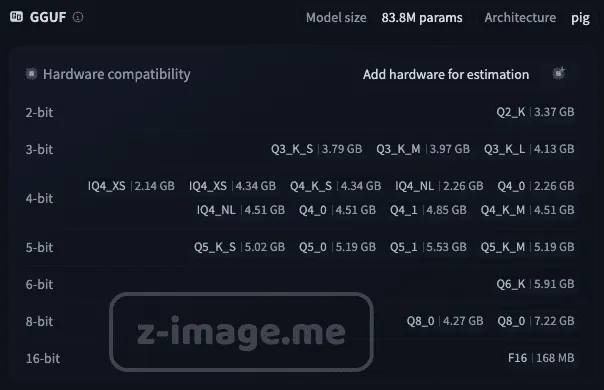
数据洞察:对于 6GB 显存设备,
Q3_K_S是物理极限。虽然Q2_K体积更小,但画质损失(Perplexity 增加)较为显著,性价比不高。
4. 工程化部署方案
4.1 Python 实现 (基于 Diffusers)
对于开发者,可以通过 diffusers 库结合 CPU Offload 策略来实现代码级调用。
import torch
from diffusers import ZImagePipeline

# 初始化管道
pipe = ZImagePipeline.from_pretrained(
    "Tongyi-MAI/Z-Image-Turbo",
    torch_dtype=torch.float16
)

# 关键优化:开启 CPU Offload 和 VAE Slicing
# 这会将不参与计算的层自动卸载到 RAM,从而降低 VRAM 峰值
pipe.enable_model_cpu_offload()
pipe.enable_vae_slicing()

# 推理
image = pipe(
    prompt="A cyberpunk city, neon lights",
    height=768,
    width=768,
    num_inference_steps=8,  # Turbo 模型标准步数
    guidance_scale=1.0      # CFG 必须为 1.0
).images[0]

image.save("output.webp")
4.2 ComfyUI 进阶部署与故障排查
在 ComfyUI 中构建工作流时,常见的错误是 mat1 and mat2 shapes cannot be multiplied。
- 根因:这通常是因为错误地使用了 SDXL 的 CLIP Loader 加载 Qwen 模型。Qwen3 是一个 LLM,其隐藏层维度与标准 CLIP 不同。
- 解决方案:必须使用
ComfyUI-GGUF插件提供的专用节点ClipLoader (GGUF)。该节点内置了对 Qwen/Llama 架构的自动识别逻辑,能够正确映射 Tensor 维度。
5. 高级应用:利用 LLM 思维链 (CoT) 优化生成
Z-Image 使用 Qwen3-4B 作为 Text Encoder,这意味着它具备 LLM 的推理能力。我们可以通过特定的 Prompt 结构激活其“思维链” (Chain of Thought),从而生成更符合逻辑的图像。
Prompt 示例:
<think>
用户想要表达“孤独感”。场景应设定在雨夜,冷色调,强调倒影和空旷的街道。
</think>
A lonely cyborg walking on a rainy street, blue and purple neon lights reflection...
通过这种 <think> 标签,模型的 Attention 机制能够更精准地聚焦于核心语义,而非被无关词汇干扰。这是 S3-DiT 架构下 LLM 与视觉生成深度融合的典型应用场景。